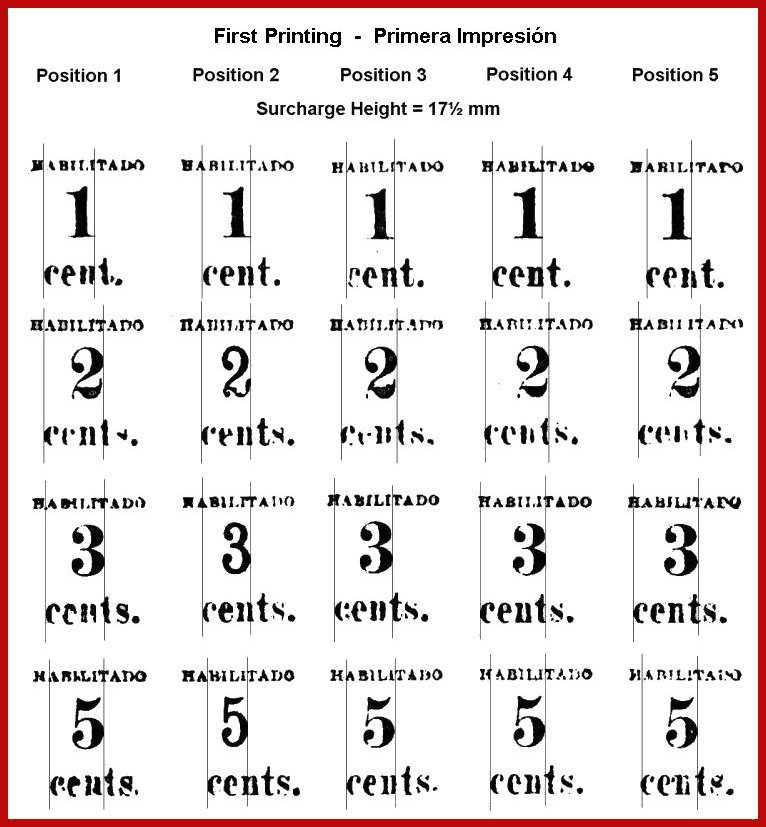
Vertical verification lines are lines traced on the images of Puerto Príncipe surcharges to verify the relative alignment of the letters and numbers in the surcharges for each of the five positions of the settings for each surcharge denomination of the five printings. These charts show the proper alignment of these lines for the genuine surcharges so that one can use them to verify whether the alignment of a sample being examined corresponds with the genuine. Forgers did not always pay careful attention to the proper alignment of the surcharge letters and number of their counterfeits and thus many of them can be identified by showing that their alignment does not correspond to those of the genuine.
The vertical verification lines shown on these charts are perpendicular to a horizontal line passing through the top of the word "HABILITADO" or the bottom of the word "cent" or "cents". Two lines are drawn for each position in each setting, one passing to the leftmost side of the letter "c" of "cent" or "cents" and another one passing to the rightmost side of the numeral of the surcharge. If one compares similarly drawn lines on an enlarged photocopy of a stamp being examined with the vertical verification lines on these charts corresponding to a genuine stamp of the same surcharge denomination, printing, and setting position and the alignment does not match, the surcharge is a forgery. Note however, that the converse is not necessarily true--a match does not guarantee that the stamp is genuine because there are excellent forgeries with the correct alignment of the vertical verification lines. Additional examination of the surcharge characteristics and ink need to be performed before a stamp can be declared to be genuine with certainty. On the other hand, also note that a match in the vertical verification lines can be used to confirm the position in the setting of a genuine surcharge. Finally, while on the subject of verification lines, verify that the height of the surcharge from the horizontal line passing through the top of the word "HABILITADO" to the horizontal line passing through the bottom of the word "cent" or "cents" measures 17.5 milimeters for the surcharges of the first and second printings and 19.5 milimeters for those of the third through fifth printings.
| 1st Printing | 2nd Printing | 3rd Printing | 4th Printing | 5th Printing |
Las verticales de comprobación son líneas trazadas en las imágenes de las sobrecargas de Puerto Príncipe para verificar la alineación relativa de las letras y los números en las cinco posiciones de cada valor de las sobrecargas de cada una de las cinco tiradas de imprenta. Estos diagramas muestran la alineación correcta de estas líneas en las sobrecargas genuinas para que uno pueda usarlos para verificar si la alineación en un ejemplar que se esté examinando corresponde con la genuina. Los falsificadores no siempre prestaron atención a la alineación correcta de las letras y números de sus falsificaciones y por lo tanto muchas falsificaciones se pueden identificar comprobando que dicha alineación no corresponde a la de los ejemplares genuinos.
Las verticales de comprobación mostradas en estos diagramas son perpendiculares a una línea horizontal que pasa por la parte superior de la palabra "HABILITADO" o por la parte inferior de la palabra "cent" o "cents". Dos líneas verticales de comprobación se trazan para cada posición de cada molde: una que pasa por el costado izquierdo de la letra "c" de "cent" o "cents" y otra que pasa por el costado derecho de la cifra de la sobrecarga. Si uno compara líneas similares dibujadas en una fotocopia en grande de una sobrecarga que se está examinando con las verticales de comprobación mostradas en estos diagramas correspondientes al sello genuino del mismo valor de la sobrecarga, la misma posición del molde, y la misma tirada de imprenta y la alineación no corresponde, la sobrecarga es falsa. Nótese sin embargo, que lo contrario no es necesariamente cierto--el hecho de que las alineaciones coincidan no garantiza que el sello sea genuino pues hay falsificaciones muy buenas con la alineación correcta de las verticales de comprobación. Se requiere una examinación detallada de otras características de la sobrecarga y de la tinta usada para poder declarar con certeza que una de estas sobrecargas es genuina. Por otro lado, podemos hacer notar que la coincidencia en las líneas de comprobación puede usarse para confirmar la posición en el molde de una sobrecarga genuina. Finalmente, ya que estamos hablando de lineas de comprobacion, se debe verificar que la distancia entre la linea horizontal que pasa por la parte superior de la palabra "HABILITADO" y la que pasa por la parte inferior de la palabra "cent" o "cents" sea de 17.5 milimetros para las sobrecargas de la primera y segunda tiradas y de 19.5 milimetros para las de la tercera a quinta tiradas.
| 1era Impresión | 2da
Impresión | 3era Impresión | 4ta
Impresión | 5ta Impresión |
Vertical Verification Lines -- Verticales de Comprobación
Chart Explanation -- Explicación del gráfico
Vertical Verification Lines -- Verticales de Comprobación
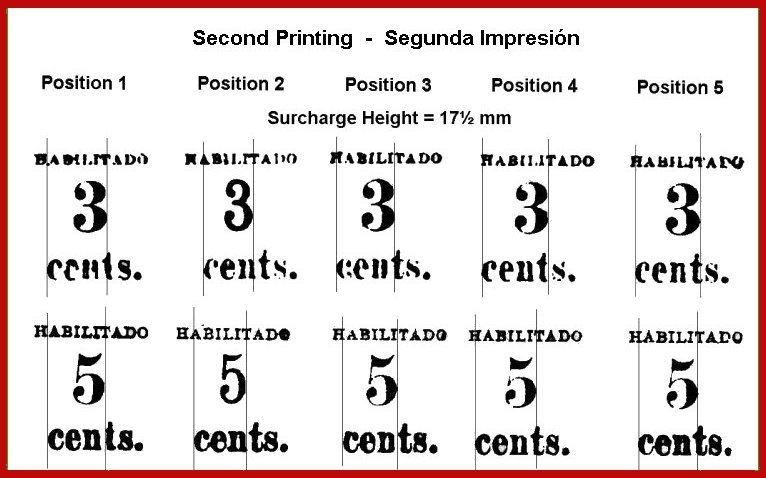
Chart Explanation -- Explicación del gráfico
Vertical Verification Lines -- Verticales de Comprobación
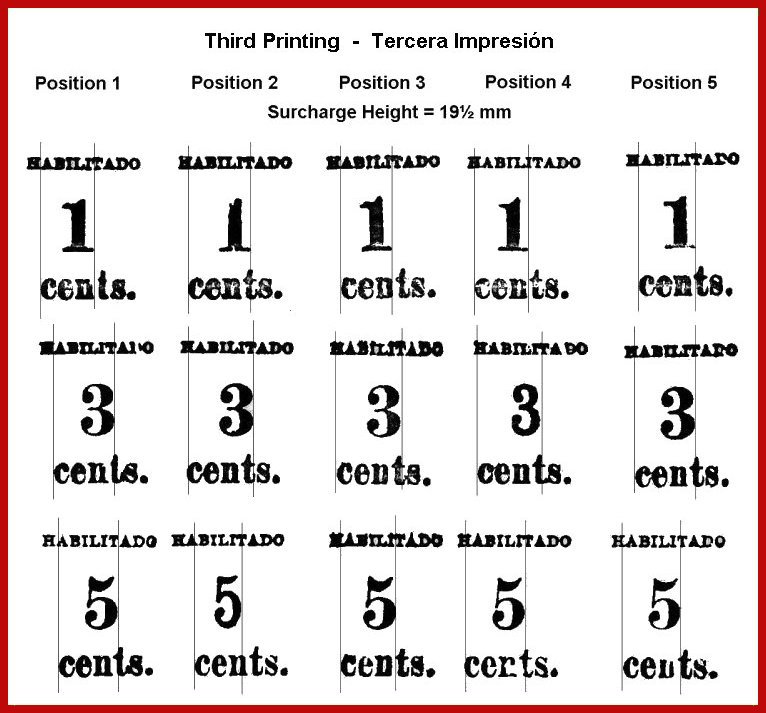
Chart Explanation -- Explicación del gráfico
Vertical Verification Lines -- Verticales de Comprobación
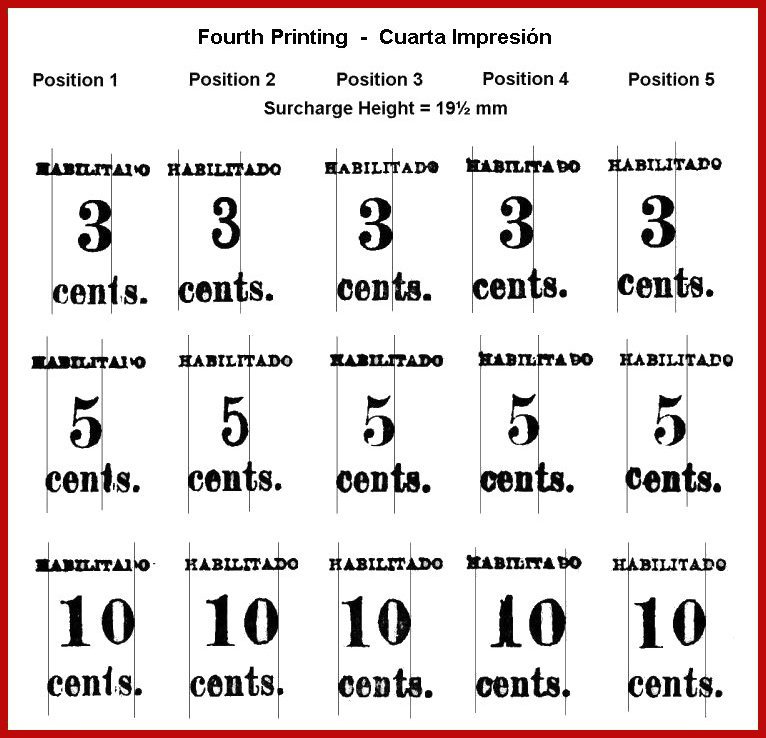
Chart Explanation -- Explicación del gráfico
Vertical Verification Lines -- Verticales de Comprobación
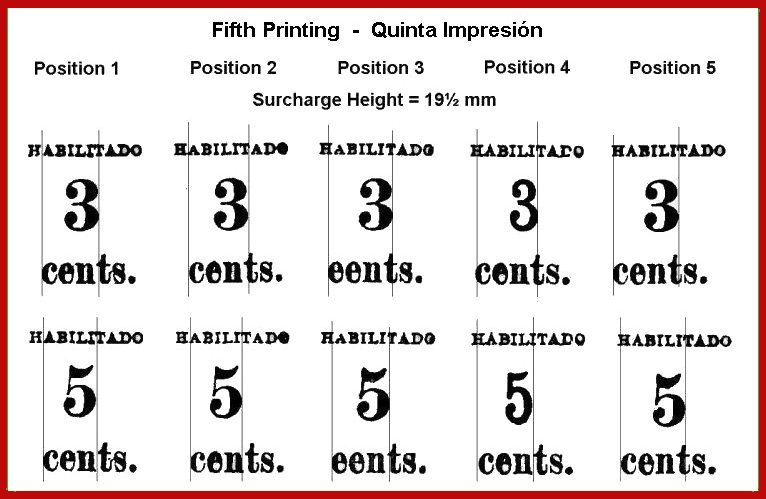
Chart Explanation -- Explicación del gráfico
Return to Puerto Príncipe Archives Home Page
| Home | Store | Collections
| Bibliography | Literature | News
| Auctions | FAQs |
| Expertizing | Dealers | Black List | Links
|
| Inicio | Tienda | Colecciones
| Bibliografia | Literature | Noticias
| Subastas | Preguntas Frecuentes |
| Certificación | Comerciantes | Lista Negra | Enlaces
Ernesto Cuesta
P.O. Box 34434, Bethesda, MD 20827, U.S.A.
E-Mail Address: ecuesta@philat.com
Tel.: 301-564-3099
This page was last modified on: July3, 2008